
Exit 8 and Resident Evil: The Unexpected Double Feature
Published on 2026-10-11
Spoilers for Zach Cregger’s Resident Evil and Genki Kawamura's Exit 8 follow.
I accidentally programmed a double feature for myself last week. I watched two recent adaptations of horror video games: Zach Cregger’s Resident Evil (2026) and Genki Kawamura’s Exit 8 (2025). My viewing experiences couldn’t have been more different; after seeing Resident Evil in a raucous opening weekend screening—and again in IMAX later in the week—I watched Exit 8 on an iPad Mini precariously balanced on a treadmill during a nor’easter. While I assumed there would be some interesting parallels in their shared origin as adaptations, I was surprised just how suitable the pairing was. In addition to a coincidentally similar emotional hook, they both choose to forefront the “game” aspects of their source material rather than attempt to bury them under more conventional cinematic techniques.

We aren’t given much into the backstories or motivations of Resident Evil and Exit 8’s respective protagonists. All we know is that both work jobs that are seen as less esteemed (“glorified postmates” for Resident Evil and an unnamed part-time job for Exit 8), and both have a newly pregnant girlfriend they are not mature enough to face. Their journeys begin as a means of fleeing their responsibilities before any of the horror actually starts.
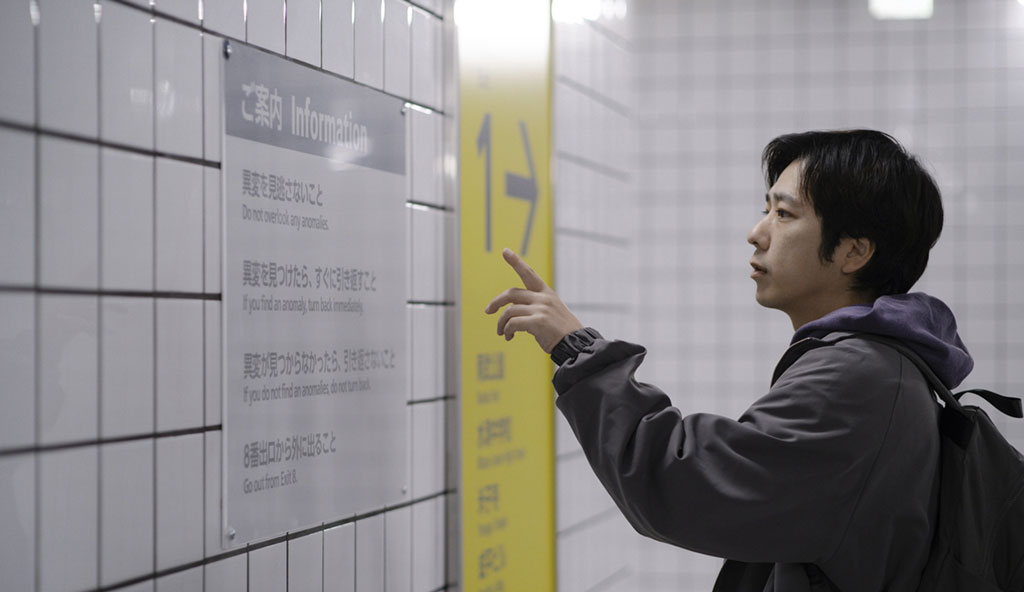
Both of these stories and characters are unique to their films; this is especially significant for Exit 8, which doesn’t have much of an original story to speak of. Never mind the lack of framing narrative, it doesn’t even have a contextualizing title screen. If you boot up the game, then you are in a hallway from a first person perspective, fully in control. The hallway is brightly lit, lined with crisp, white tiles and the occasional ad for local businesses to resemble a Japanese metro station. After a few trips down identical hallways, you are greeted by a diegetic sign that explains the rules:
- Do not overlook any anomalies
- If you find anomalies, turn back immediately
- If you don’t find anomalies, do not turn back
- To go out from Exit 8
These rules are simple and they do not change. Players walk through the same hallway repeatedly, looking for differences until they successfully get through eight consecutive loops. Some of these “anomalies” are as simple as an askew light, but others take more obvious horror inspiration. In my first playthrough, I turned a corner to see two salarymen standing side-by-side like The Shining twins with 401ks. Later, I was chased by a sudden, rushing river of dark liquid1.
Interestingly, while Kawamura’s film weaves in a framing narrative about impending fatherhood, it does not tie itself into knots to try to adapt the more obviously ludic conceits into something more palatable for filmgoers. The film opens in the first person, and maintains this perspective for a nearly seven minute unbroken shot. The only glimpse of our protagonist is in his sad reflection in the subway windows—an especially bold move considering said protagonist is played by ex-boyband-er Kazunari Ninomiya. While the rest of the film is shot more conventionally, it does immediately set the tone as a self-aware video game adaptation. In this unbroken shot, the protagonist and viewer travels deeper into the station in a way that echoes the emergent stories players create by traversing in real time to a destination.
Where most films would cut from one location to the other, a video game fundamentally centers the act of travel. Interestingly, director Gus Van Sant identified this core characteristic of games when researching for his non-video-game-movie Elephant (2003). In his interview with The Story of Film: An Odyssey (2011)2, he notes:
[v]ideo games are often doing what we were doing in Gerry. To get from point A to point B, you have to actually travel there. You can't cut like in cinema. You cut to the new location. You actually walk like in reality.
Exit 8’s film adaptation recognizes the value of walking immediately in immersing the audience in the protagonist's headspace--we feel the weight of each step as he learns more about his predicament and reacts to it. While it only has a few shots in the first person, it’s probably not a coincidence that Cregger built his Resident Evil movie around traversal as well. He has spoken in interviews about wanting to replicate the games’ feelings of resource and health management,and Cregger has also seemingly recognized the importance of real-time movement to capturing the feeling of playing a game. His protagonist’s journey across Raccoon City is helped by cuts, but our understanding of the world and what is happening in it is still closely restricted by the pace at which the protagonist moves through it to his destination.
The two films diverge in their approach to adaptation when it comes to its protagonists learning the rules of the game. While Resident Evil’s protagonist plays video games and applies what little he knows about fire arms from them to comedic affect, he never learns other key rules to Resident Evil. He doesn’t find the key that matches a weird lock until he’s broken its fence; he never uses the typewriter he finds; he walks right past valuable first aid sprays. By contrast, Exit 8’s protagonist—The Lost Man—finds a diegetic sign identical to the one in the original game and reads the exact same rules a player does. As he continues through the hallway loops by himself, he repeats the rules and the things he sees aloud, not unlike the streamers who made that game so successful. When he finally meets another character—something that does not occur in the games—it becomes a conversation about what they see.
This faithful adaptation occasionally chafes against the more cinematic explorations of the new framing narrative. The abstract anomalies The Lost Man encounters are increasingly representative of his anxiety towards fatherhood. As such, the protagonist often spends time staring at an anomaly in existential terror when a player would have immediately spun around to begin the loop again. Given how transparent the film is with its game rules, it can be frustrating to see the protagonist be “bad” at the game.
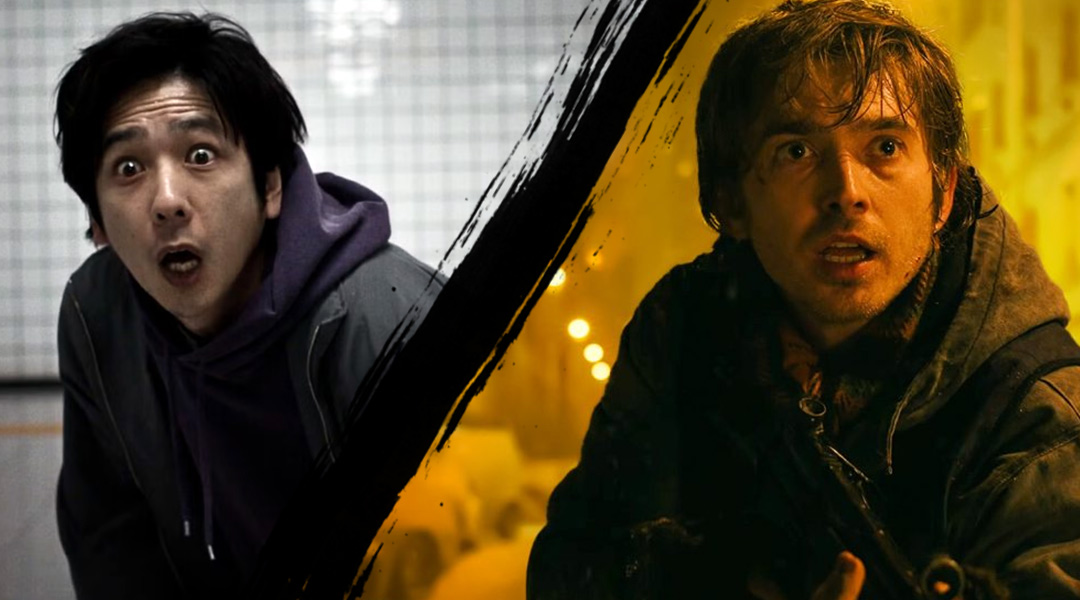
Resident Evil’s protagonist is similarly “bad” at the game, and his numerous failures are often framed as comedic breaks in an otherwise tense script. As a result, though, he does less to confront anxieties about fatherhood while he is busy running in terror past the metaphors Resident Evil throws his way. The film additionally never forgets his tally of misses, and ultimately recontextualizes them by the ending.
While the literal game rules sometimes conflict with the film’s cinematic inclinations, director Kawamura is wise to weave the concept of looping through actions beyond just the hallway. The film ends in a nearly shot-for-shot recreation of its opening scene. The main difference is we see the protagonist’s face straight on instead of obscured in reflection while he deliberates what to do. Ultimately, he makes a different, more active choice than in the opening sequence. Repetition is a core part of any game and explicitly important to the hallway loop in Exit 8. In the film, Kawamura recognizes that through repetition, the player always improves. While Resident Evil’s protagonist is denied the opportunity to learn from his experience, Exit 8’s protagonist not only conquers the rules of the supernatural hallway, but in repeating the inciting incident, he emerges better prepared to make the right choices and face his future.
Footnotes
-
While this is clearly reminiscent of the other famous hallway sequence in The Shining, in the film adaptation, it is more clearly muddy water full of debris. This evokes the horrifying tsunami footage we witnessed in 2011 for an additional metatextual layer. ↩
-
Readers in the US can watch this episode with the interview free on Tubi. ↩